On February 3, 2026, 22,580 drones lifted off over Luogang Park in Hefei, China. Every one of them flew from a single computer. Only about 25 failed to launch.
The show, produced by EHang Egret for the China Media Group Spring Festival Gala, set the Guinness World Record for the most drones airborne at once from one computer. It beat the previous mark of roughly 15,900 by more than 40 percent, and it aired to an audience estimated in the hundreds of millions.
It's a genuine engineering achievement, and the team behind it earned the recognition. Records like this pull the whole industry forward.
But it also puts a question in front of every operator in this business: if the ceiling on drone count keeps rising, is that actually where the value is?
We don't think so.
The drone count arms race has a ceiling problem
Fleet size is the easiest number to sell and the easiest number to compare. It's also the one that means the least to the person standing in the field.
Here's the honest version. An audience cannot count drones. Past a few hundred units, the difference between 500 and 800 reads mostly as resolution: smoother curves, finer detail, more convincing 3D. Real, but subject to diminishing returns. Nobody walks out of a show saying it needed 200 more drones.
What they say is how it made them feel. And feeling is not a function of unit count.
Meanwhile the number that is rising fast is the one on the invoice. Every additional 500 drones adds batteries, crew, transport, charging infrastructure, airspace footprint, and launch site square footage. For the overwhelming majority of events, whether festivals, resorts, sports, brand activations, or municipal celebrations, the marginal drone is a worse investment than almost anything else you could spend that budget on.
The interesting question isn't how big the canvas gets. It's what else the sky can do.
What changes when the audience is part of the show
At Creative Skies we've spent the last several years on a different problem: how do you turn a performance people watch into one they take part in?
Three things move that needle.
1. Synchronized audio on every phone
Outdoor audio is the quiet failure of most drone shows. PA coverage falls off fast, wind moves it around, and half your audience hears a thin version of a soundtrack that was scored beat by beat to the choreography. The emotional payload of the show lives in that sync, and most of the crowd never gets it.
SkyRender Sync puts the soundtrack on every attendee's phone, clock synced to the flight. Everyone hears the same downbeat at the same instant no matter where they're standing. No app install, no PA truck, no coverage map.
You can try the live demo on our site with two phones and see the sync for yourself.
2. The sky as a scannable surface
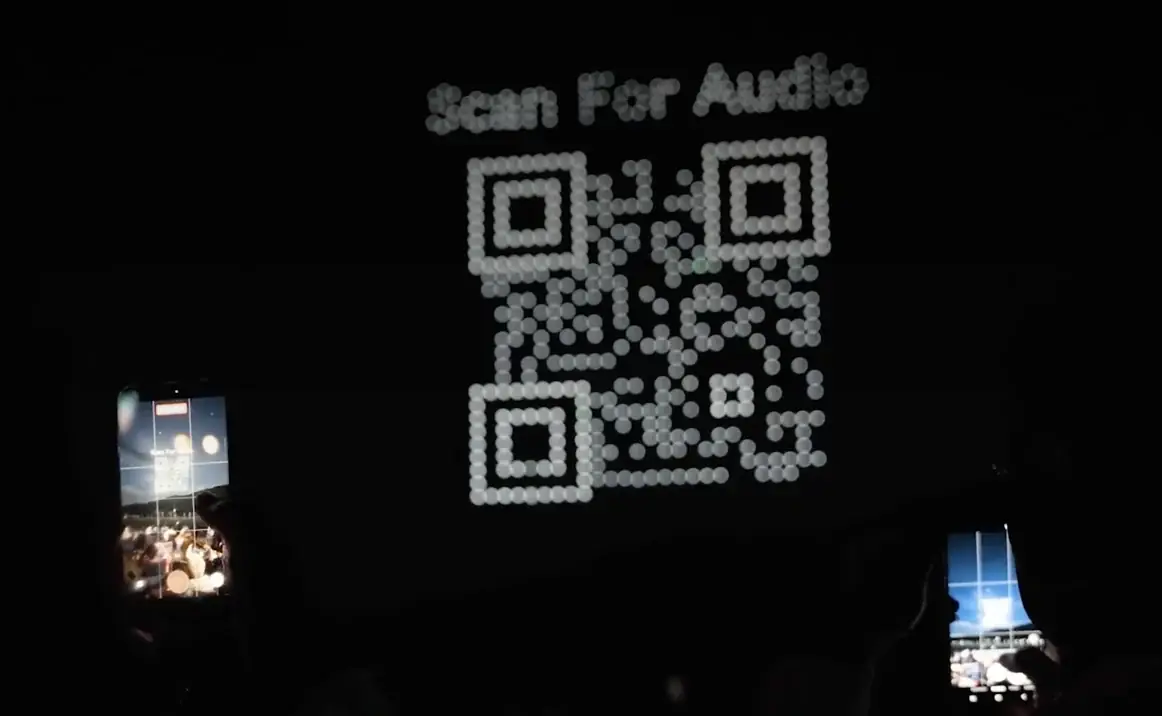
A QR code formed by drones is the only advertisement in history that thousands of people photograph on purpose.
That's not a gimmick. QR scanning is now default consumer behavior. Over 100 million Americans are expected to scan a code in 2026, roughly one in three, and adoption sits above 80 percent among Gen Z and Millennials. The friction that killed QR codes a decade ago is gone.
Which means the finale can hand off to a sponsor landing page, a ticket presale, a giveaway entry, an exclusive trailer, or a donation page. The show doesn't end when the drones land. It moves to 10,000 phones.
3. AR preview before takeoff
Guests can point a phone at the sky and watch the formations appear before the first drone leaves the pad. It's an engagement window that used to be dead air, and it produces social content hours ahead of the actual performance.
For our clients it does something else too. It kills the approval guessing game. Stakeholders see the show in their actual venue, at scale, before anyone signs off.
The part sponsors actually care about
Here's the shift that matters more than any of the visual technology.
Brands have stopped buying impressions. Sponsors in 2026 want the same granularity from a live activation that they get from a digital campaign: impressions, dwell time, engagement, lead capture. Events that can't produce those numbers are losing partners to events that can.
The gap is real and it's documented. 39 percent of marketers say they struggle to prove ROI on experiential campaigns, and 56 percent find it genuinely difficult to measure. That's not a small inefficiency in a category where global spend crossed $138 billion in 2025.
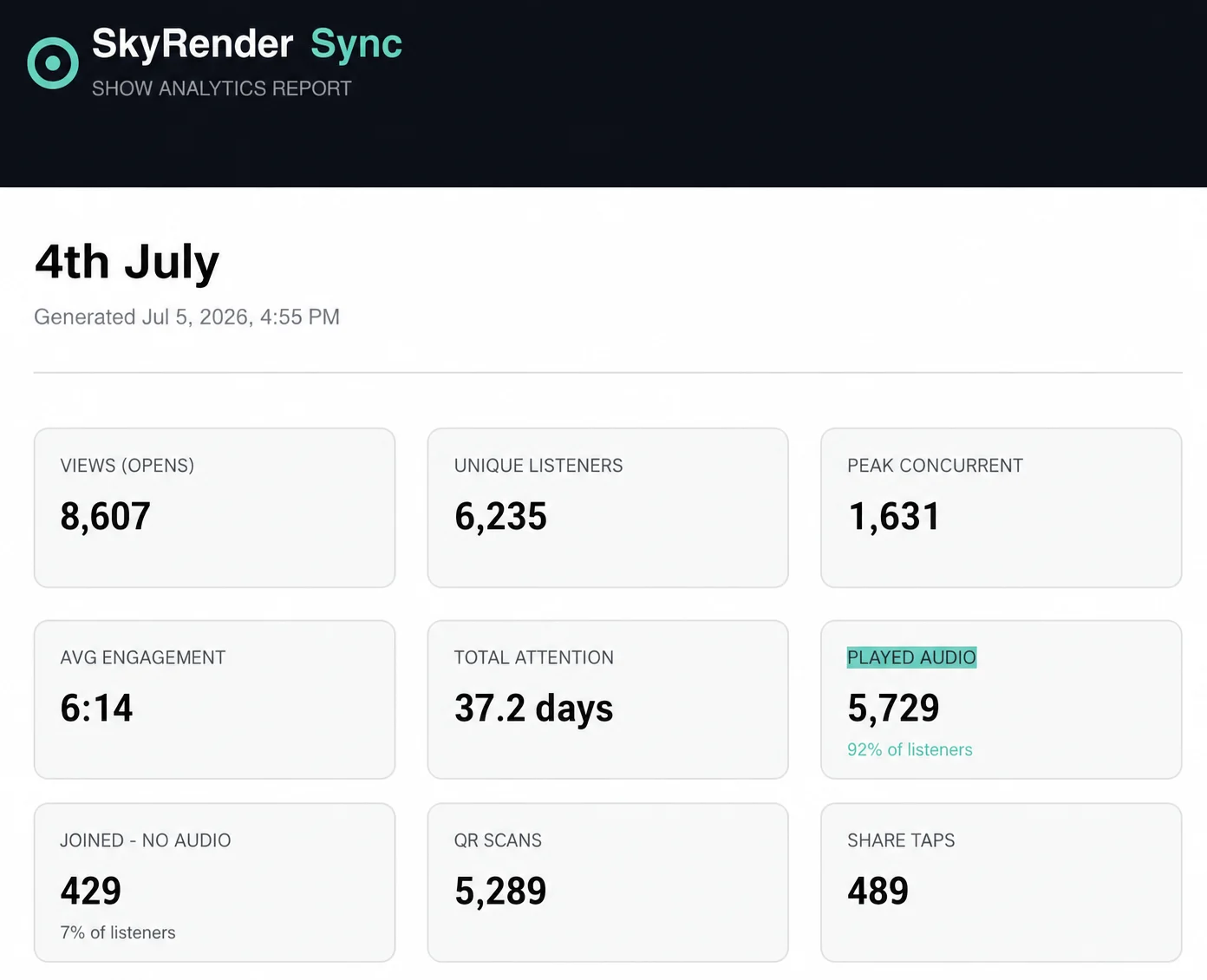
A traditional drone show reports one number: estimated attendance. An instrumented drone show reports a great deal more.
| Metric | What it tells the sponsor |
|---|---|
| QR scans | Verified interaction, not estimated exposure |
| Unique synced listeners | Actual engaged audience size, counted not guessed |
| Click throughs to the sponsor site | A top of funnel handoff |
| Conversions (entries, sales, signups) | Direct attribution |
| Geographic and device distribution | First party audience data |
That's the difference between "about 15,000 people were probably looking up" and a spreadsheet the sponsor's CFO can read.
It also changes what a drone show is on the budget line. It stops being an entertainment expense and becomes a measurable channel, which is a very different conversation with a very different approval threshold.
What to ask before you book any drone show
If you're evaluating operators, drone count is the wrong lead question. Ask these instead.
- What does the audience get on their phone? Anything, or do they just look up?
- What data will I have the morning after? Get the specific metrics in writing.
- Can I see the show in my venue before I approve it? AR preview, not a generic sizzle reel.
- What's the audio plan for the far edges of the crowd?
- Show me the FAA waiver, the insurance certificate, and the safety record. This one is not optional, ever.
Any operator can quote you a drone count. Fewer can answer the rest.
The next chapter
Fleet records will keep falling. Someone will fly 30,000 drones, and it will be spectacular, and we'll congratulate them too.
But the operators who define the next decade won't be the ones with the biggest fleets. They'll be the ones who figured out that the sky is an interface, not just a canvas. That every phone in the crowd is a channel. That every formation can be interactive. And that sponsors will pay a premium for proof instead of estimates.
When the sky becomes scannable. When every phone is part of the score. When engagement is counted instead of assumed.
That's when a drone light show stops being something people watched and becomes something they were part of.
That's the future we're building.
Keep reading: The Masters of the Universe drone show over Los Angeles set a world record for the brightest aerial image ever.