So you saw a drone show (maybe a glowing dragon, a spinning logo, a 500-drone American flag waving over a stadium), and the same question always comes up: how on earth does that actually work?
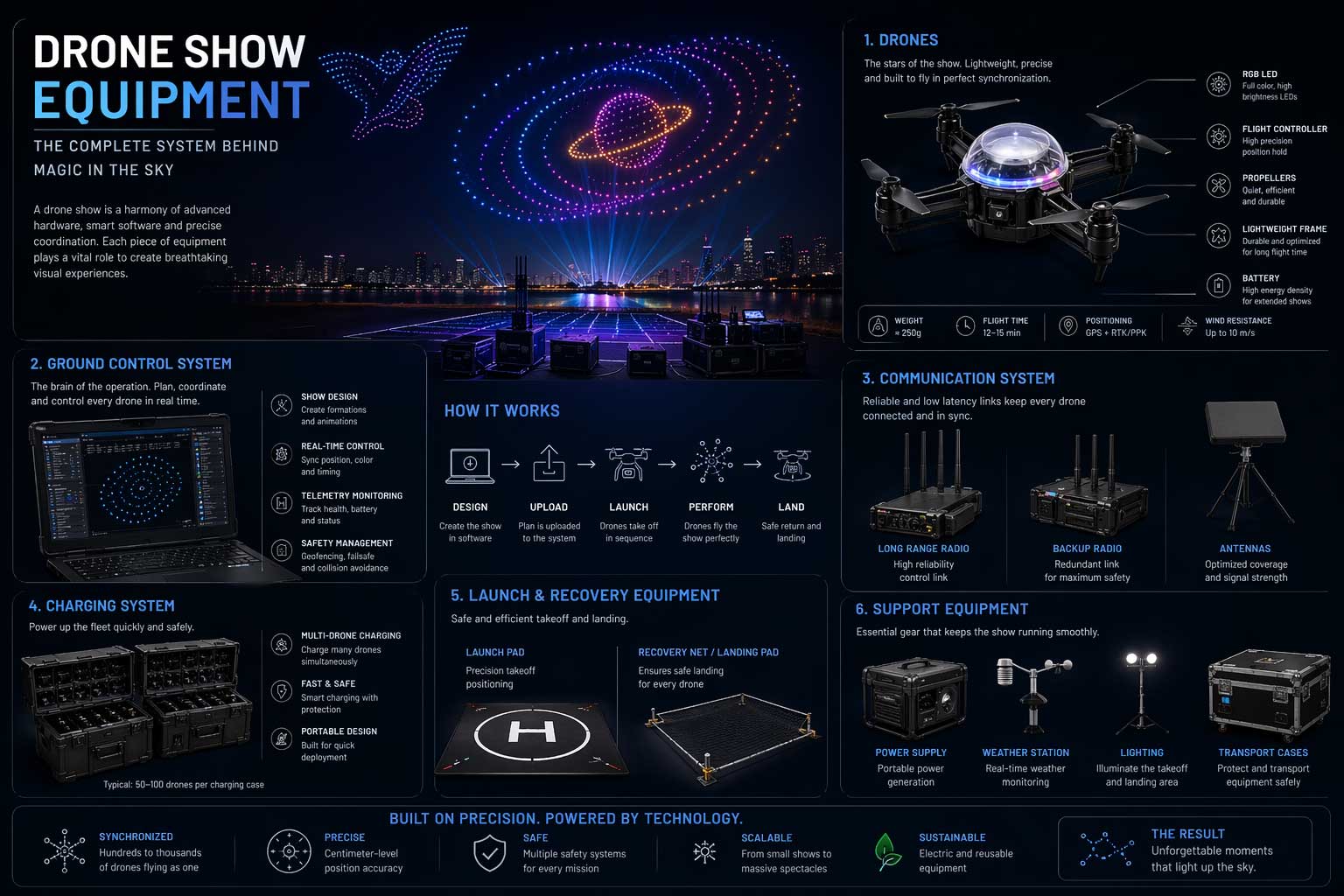
The short answer: every drone in that swarm is its own tiny, self-piloted aircraft, following a script down to the centimeter, talking to the ground over multiple radios at once, and watched over by safety systems that would make a commercial pilot jealous. Let's walk through it, system by system, in plain English.
Step 1: The Choreography Comes First
Before a single drone leaves the ground, the show is built inside a 3D animation environment. Think of it as the choreography studio: every drone is a dancer, and the designer maps out exactly where each one needs to be, frame by frame, for the entire show.
Out of that animation comes a flight path file for every single drone, with its precise coordinates in space at every moment, plus the color, brightness, and timing of its onboard light. A 500-drone show is really 500 individual scripts running in lockstep.
That choreography then runs through a simulation system, a virtual rehearsal that flies the entire show in software first, checking for things like drones getting too close to each other, formations that strain the timing, or paths that drift outside the safe zone. Nothing flies for real until the simulation is clean.
Step 2: The Drone Itself
Each drone in a show is purpose-built for formation flying. They're small (around 540 grams, lighter than a can of soda), built with carbon-fiber frames, and wrapped in a protective propeller cover so the spinning blades are physically shielded.
Inside, every aircraft carries:
- A double-IMU (inertial measurement unit) and double-magnetometer (two of each), so if one sensor disagrees with the other, the flight controller knows something is off and can react instantly. Two of everything is a recurring theme in drone-show engineering.
- An RTK antenna on top. The secret sauce we'll get to in a second.
- A 4S smart battery good for about 31 minutes of flight (shows themselves usually run 10 to 20 minutes).
- A 0–20 watt RGB LED that's bright enough to be seen from a stadium's worth of seats and dims itself based on ambient temperature.
It's basically a flying lightbulb with the brain of a navigation computer.
Step 3: RTK Positioning: GPS, but Surgical
Here's the part that always gets the biggest "wait, really?" reaction.
Regular GPS (the kind in your phone) is accurate to about 3 to 5 meters. That's fine for getting you to a coffee shop. It is absolutely not fine for flying 500 drones in a tight grid 1.5 meters apart at 100 meters in the air.
Drone shows use RTK (Real-Time Kinematic) positioning, which gets every drone down to ±5 centimeters horizontally and ±6 centimeters vertically. That's the difference between "somewhere on this block" and "this exact dot on the floor." Each drone simultaneously listens to four satellite constellations (GPS (USA), GLONASS (Russia), Galileo (EU), and BeiDou (China)), so even if some satellites are blocked by buildings or trees, there are still plenty of others to lock onto.
The thing that makes RTK work is the next system on the ground.
Step 4: The Ground Base Station
The Ground Base Station is a small tripod-mounted unit set up on-site before the show. Its only job is to sit perfectly still in a known location and broadcast something called RTCM correction data to every drone in the air.
Here's why that matters. The base station knows exactly where it is, and it's also receiving the same satellite signals as the drones. By comparing the satellites' "guess" of its position against where it actually is, the base station calculates the tiny atmospheric errors in the GPS signal in real time. It then radios those corrections out to every drone in the air, who use them to clean up their own position to the centimeter.
If you want a metaphor: the base station is like a tuning fork the whole orchestra checks against, several times a second.
Step 5: Two Conversations at Once, Wi-Fi + Radio
Talking to a drone in flight has to be completely reliable. So drone shows use two independent communication systems running at the same time:
- 5.8 GHz Wi-Fi, the high-bandwidth channel, used to push detailed telemetry and the heavy stuff.
- Multi-frequency radio data link (in the 868–928 MHz range, depending on country), the long-range, low-bandwidth backup that punches through interference and reaches farther.
The two systems are redundant. If one channel gets noisy because someone fired up a Wi-Fi camera nearby or there's RF interference from a nearby venue, the other channel keeps the conversation going. The drone never goes silent.
Step 6: The Ground Control Station
On the operator's side, there's a laptop running the ground control station software (sometimes called the "host computer"). This is the conductor's score. The operator can see every drone on a live map, watch each one's battery, GPS lock, link quality, and altitude, and trigger the show with one click.
From the ground station the operator can also:
- Auto-number the entire fleet: drop the drones on their takeoff grid and the system figures out which is which automatically.
- Pause the show mid-air, hold every drone in place, and resume when ready.
- Trigger an immediate fail-safe landing for the entire fleet from a single button.
Step 7: Power on the Ground
Each drone runs on a 4S smart battery. "Smart" meaning the battery itself talks to the drone, reporting voltage, temperature, cycle count, and remaining capacity. Between rehearsals and shows, those batteries live in battery charging boxes, which are basically high-throughput pit stops that can charge dozens of packs at once and keep them within their safe temperature window.
For a 500-drone show, the ground operation looks a lot like a Formula 1 garage: rows of charging boxes, a checked flight log for every aircraft, and a maintenance record for every battery (which gets retired after a fixed number of cycles to stay safely within spec).
Step 8: Safety Systems (the Quiet Heroes)
This is where the engineering really earns its keep. Every drone in the show carries multiple, layered safety systems running constantly in the background:
- Locked-rotor protection: if a propeller jams, the motor cuts power immediately instead of trying to brute-force through.
- Low-power protection: if a drone's battery gets unexpectedly low, it abandons its choreography and lands itself at a pre-defined safe spot.
- Fail-safe protection: if a drone loses both communication channels, it triggers a controlled, automatic landing on its own.
- Physical propeller guards: full-perimeter cages around the props, so even a worst-case bump is blunted.
- Abnormal landing alarm: if a drone touches down somewhere it wasn't supposed to, it sounds an audible alarm and turns its lights on at full brightness so the crew can find it instantly.
- Sensor cross-checks: the double-IMU and double-magnetometer continuously verify each other, so a single bad sensor reading can't cascade into a bad flight decision.
How Creative Skies Keeps Audiences Safe
This is the part we take seriously, because no light show in the world is worth a single person getting hurt.
Beyond the manufacturer's built-in safety stack, Creative Skies operates on top of cutting-edge flight planning and monitoring technology, plus our own layered approach to airspace control. The headline feature: multiple, overlapping geo-fences defined for every show.
A geo-fence is exactly what it sounds like: an invisible boundary in 3D space that the drones are not allowed to cross. We don't rely on just one. Every show is built with several layers:
- An outer perimeter defining the overall maximum flight box for the entire fleet.
- An inner performance volume where the choreography is allowed to live.
- A dedicated audience-side exclusion zone: a no-fly buffer between the show and the crowd that the drones physically cannot enter, no matter what the flight path says.
- Altitude floors and ceilings that prevent any drone from descending toward people below or climbing into protected airspace above.
If something ever started to drift toward one of those boundaries (which it shouldn't, because the simulation already ruled that out), the drone would trigger its fail-safe long before it ever reached the audience. It's belts and suspenders and a parachute. That's how we like it.
Want to See a Creative Skies Show in Person?
Whether it's a wedding, a stadium, a brand activation, or a city celebration, we'd love to design a show for you. Tell us what you're imagining and we'll show you what's possible.
Putting It All Together
So the next time you watch a drone show, picture the full chain in motion:
- A choreographer designs the show in 3D and exports a unique flight script for each aircraft.
- A simulation system flies the whole thing virtually first to confirm it's safe and clean.
- On-site, a tripod-mounted base station starts broadcasting RTK corrections.
- Every drone locks onto four satellite constellations and refines its position to within a few centimeters.
- The ground control station hands each drone its choreography and arms the fleet.
- Two redundant communication links (Wi-Fi and radio) keep every drone in touch with the ground.
- The show flies. Every drone holds its slot in the sky to the centimeter, lighting up exactly when it should.
- Layered geo-fences and onboard fail-safes are quietly watching the whole time, ready to intervene.
- At the end, the swarm descends in formation and lands within a few centimeters of where it started.
It looks like magic. It's actually satellites, sensors, redundant radios, and a lot of careful engineering all working together so a designer's idea can light up the sky for a few minutes. Safely, every time.
And that, in a nutshell, is how a drone show works.