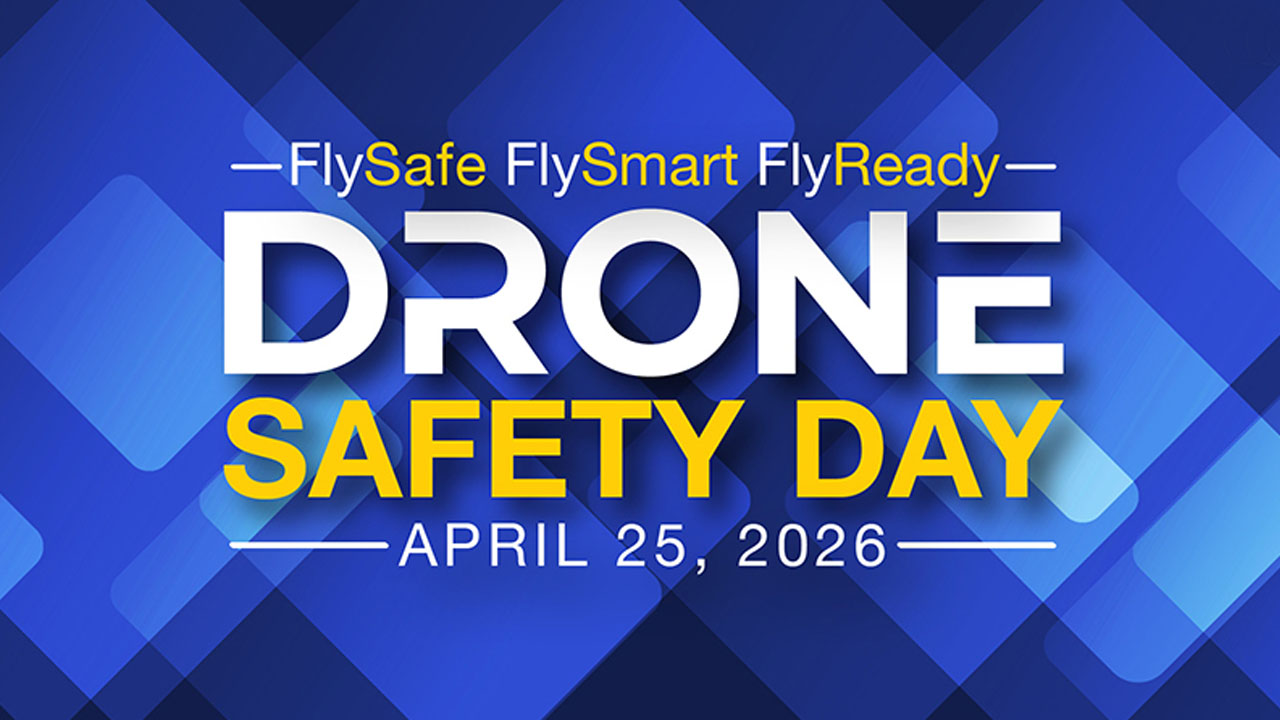
Every year, on the fourth Saturday of April, the Federal Aviation Administration hosts Drone Safety Day, a nationwide outreach event encouraging pilots, operators, partners, and the public to take a beat and recommit to one simple idea: the airspace is shared, and keeping it safe is on all of us.
In 2026, that day falls on Saturday, April 25.
What Drone Safety Day Actually Is
Drone Safety Day was launched by the FAA to bring together drone pilots, industry, public-safety agencies, educators, and community organizations around a single, very straightforward message: fly smart, fly safe, and know the rules.
The FAA encourages partners across the country to host events on or around the date: safety demos, school visits, community fly-ins, training sessions, and conversations about responsible operation. It's part awareness day, part open house for the drone community, and part reminder that the rules that keep the airspace safe are not optional.
The Drone Safety Day Materials Playbook published by the FAA lays out exactly how organizations can get involved, from hosting a local event to amplifying the safety message on social channels, and includes ready-made resources for educators, clubs, and operators.
The Rules Every Pilot Should Know
Whether you fly recreationally on weekends or operate professionally for a living, a handful of FAA basics define what "safe" actually looks like:
- Register your drone. Most drones over 0.55 lb (250 g) must be registered with the FAA before flight.
- Pass the right test. Recreational flyers complete TRUST (The Recreational UAS Safety Test). Commercial pilots earn a Part 107 Remote Pilot Certificate.
- Know your airspace. Use B4UFLY or an equivalent app before every flight to check controlled airspace, restrictions, and TFRs (temporary flight restrictions).
- Get authorization where required. Controlled airspace requires a clearance, often through LAANC (Low Altitude Authorization and Notification Capability) for near-real-time approval.
- Comply with Remote ID. Most drones operating in U.S. airspace are now required to broadcast Remote ID, basically a digital license plate for drones in flight.
- Keep it in sight. Maintain visual line of sight, fly under 400 ft AGL, never over people without proper authorization, and never in conditions or locations the rules don't allow.
- Don't fly impaired. Same standard as any aircraft. A drone is one too.
None of this is bureaucratic theater. Every line on that list exists because the airspace above the United States is one of the busiest in the world, and a drone in the wrong place at the wrong time can end a lot of things very badly.
Where Drone Light Shows Fit In
A drone light show isn't a hobby flight. It's a professional aviation operation, closer in spirit to a commercial flight than to flying a quadcopter at the park, and the FAA regulates it accordingly.
To fly a show legally and safely, an operator needs:
- Pilot(s) holding a current Part 107 Remote Pilot Certificate.
- Specific FAA waivers for things that go beyond standard Part 107, most notably flight over people, flight at night, and operating multiple drones from a single pilot (essential for any swarm).
- Proper airspace authorization for the venue, often through LAANC or a written agreement with the local control tower.
- Remote ID compliance across the entire fleet.
- An operations and emergency plan reviewed before the show, including failure modes, exclusion zones, and abort procedures.
For shows that include pyrotechnic payloads on the drones themselves, an additional FAA Hazardous Materials Waiver is required. It's a rare authorization held by only a handful of U.S. companies, and Creative Skies is one of them. That waiver is what lets us fly pyro drone shows: synchronized drone formations carrying live pyrotechnic effects, fully authorized by the FAA.
FAA-Certified, Safety-First Drone Shows
Creative Skies operates under full FAA Part 107 authority, with active waivers for night, over-people, and multi-drone operations, plus a Hazardous Materials Waiver for pyro drones. Safety is our first deliverable on every show.
How Creative Skies Operates
The visible part of a drone show is the choreography. The invisible part, and the one that actually makes the visible part possible, is the safety stack underneath it.
On every Creative Skies show, that stack includes:
- Soft + hard geo-fences. Multi-layered 3D boundaries: soft zones that trigger system warnings and corrections, plus hard exclusions the swarm physically cannot cross, including a dedicated audience-side no-fly buffer.
- Designated controlled flight area. Every show flies inside a pre-defined, mapped, and posted flight box, with takeoff and landing zones isolated from the audience and from non-essential personnel.
- RTK-grade precision. Every drone locked to centimeter-level accuracy through Real-Time Kinematic positioning, not the 3–5 meter accuracy of consumer GPS.
- Redundant communications: two independent radio links per drone, so a noisy channel can't sever the conversation.
- Secured command and control. All command and control systems operate on secured communication links with active interference monitoring and built-in redundancy.
- Simulation before flight. Every show flies in software first, every formation, every transition, every landing, to catch conflicts, drift, and proximity violations before a single rotor spins for real.
- VO + RPIC coordination. A certified Remote Pilot In Command (RPIC) runs the operation, with dedicated Visual Observers (VOs) positioned to cover every angle of the flight box. Continuous radio comms between RPIC and VOs keep the operating picture complete in real time.
- Waiver-backed operations. Every show flies under specific FAA waivers (night, flight over people, multi-drone control) and case-by-case airspace authorizations. Nothing happens outside a documented authorization.
- Onboard fail-safes: locked-rotor protection, low-power auto-land, comm-loss auto-land, and an audible alarm with full-brightness LEDs on any abnormal landing.
- FAA-compliant anti-collision lighting. All drones meet FAA visibility requirements through high-intensity LED systems visible for multiple miles.
- $5M liability insurance, plus an operations team that has logged shows for over a million live viewers without a safety incident.
None of these are nice-to-haves. They're FAA-grade differentiators: soft and hard geo-fencing, RTK precision, redundant comms, pre-flight simulation, a controlled flight area, waiver-backed operations, and tight VO + RPIC coordination. Every one of those layers exists for the same reason Drone Safety Day exists: because the people on the ground are watching a show, not thinking about airspace, and our job is to make sure they never have to.
Go / No-Go: When We Don't Fly
The most important safety decision on a drone show isn't a fail-safe in the air. It's the decision made on the ground, before takeoff, about whether to fly at all.
Every Creative Skies show is governed by a written set of abort criteria reviewed by the pilot in command. We will not launch if:
- Wind exceeds system limits. Our standard ceiling is 23 knots sustained, with tighter thresholds on gusts. Forecast or on-site readings outside that envelope hold the show.
- GPS integrity is degraded. RTK lock and satellite count must clear our pre-flight thresholds across the entire fleet. Anything less is a no-go.
- RF interference is detected. Both the Wi-Fi and the radio data link have to come up clean. Sustained interference on the operating frequencies cancels the launch.
- Airspace conflict is unresolved. A surprise TFR, an unexpected NOTAM, or unplanned aircraft activity affecting the operating volume holds or scrubs the show.
- Visual observers cannot maintain coverage. If the spotters can't see the full flight box, we don't launch.
- Precipitation is present or imminent. Drone shows fly in dry air. Rain in the active flight window is an automatic scrub.
- Battery temperatures are out of spec. Cold-soaked or overheated packs are pulled before they ever leave the charging boxes.
None of those calls are popular when 50,000 people are waiting for a show. They're also non-negotiable. A scrubbed show is a delay. An unsafe show is a headline.
What Creative Skies Brings to a Show
Beyond the safety culture, a few things define what working with Creative Skies actually looks like:
- Full FAA authority. Active Part 107 certification, with waivers for night operations, flight over people, and multi-drone control from a single pilot.
- Pyro drone capability. Creative Skies holds an FAA Hazardous Materials Waiver authorizing pyrotechnic payloads on drones in flight. It's one of only a handful of such waivers in the United States.
- World-record-grade equipment. Our fleet is supplied by the manufacturer that holds the Guinness World Record for the most drones flown simultaneously: 16,000+ in a single show.
- Track record. Over a million live viewers across our shows, $5M in liability insurance behind every flight, and zero safety incidents.
- Western US strongholds, nationwide reach. Active home markets in San Diego, Los Angeles, Phoenix, Scottsdale, and Oceanside, with deployment available coast to coast.
- Every kind of event. Weddings and proposals, stadium halftime shows, corporate brand activations, festivals, holiday celebrations, and city-scale public events.
- AR show previews. Through our SkyRender integration, clients can preview their custom drone show in augmented reality before a single drone takes off.
The short version: when you book Creative Skies, you're booking a team that takes the rules of the airspace as seriously as the wow on the ground.
How You Can Participate
Drone Safety Day is built for community participation. A few practical ways to get involved on April 25:
- Pilots: Take a few minutes to refresh your knowledge: re-take the TRUST test, review B4UFLY, walk through your pre-flight checklist. Habits drift; days like this exist to reset them.
- Schools and clubs: The FAA's Materials Playbook includes ready-to-use resources for STEM events, demos, and classroom activities. Drone careers are real, growing, and need new pilots.
- Public-safety agencies: Host or attend an event. Drones are increasingly part of fire, police, and search-and-rescue operations. Drone Safety Day is a natural moment to engage your community on how and why.
- Industry: Talk about your safety practices publicly. Show your work. Every show that goes well, every flight without incident, is a vote for the entire industry continuing to fly.
Drone shows are entertainment. Drone flights are aviation. The line between those two things is the safety culture every operator chooses to enforce, every single time the rotors spin.
April 25 is a good day to thank the FAA, the public-safety community, and every responsible operator out there for keeping the airspace open. It's also a good day to remember that the people who make a show feel like magic are the same people sweating the rules behind it.
Creative Skies is proud to fly within the highest FAA standards on every show. Today, tomorrow, and every Drone Safety Day after this one.